|
|||||||


| Sponsored Links (Register now to hide all advertisements) |
|
|
 |

|
Thread Tools | Display Modes |
 05-24-2011, 11:51 PM
|
#41 |
|
Senior Member
Join Date: May 2010
Location: Mpls, MN
Posts: 27,582
|
 Re: Vapor Lock 101 ?
"I don't think you will find a cure for your vapor lock. I think you can find out why your Model A is not performing like it should. Good Luck!!!! "
Ah, but I have found the cure for vapor lock! Don't use corn crap gas! |

|

|
|
05-25-2011, 12:37 AM
|
#42 |
|
Senior Member

Join Date: May 2010
Location: on the Littlefield
Posts: 6,675
|
Re: Vapor Lock 101 ?
Could it be something as simple as not cleaning up the burr from the end of the fuel pipe from when it was cut to length ---debris inside the pipe can also create points for bubbles to propogate, and I suspect that the sharp burr left from cutting the tubing is near a perfect shape to use to take advantage of the surface tension that exist in the boundary layers of a bubble to inhibit it's movement.
The pet hamsters water bottle uses the slight restriction to keep water in the bottle-- I have had condenser lock, points itus, and wads of jelly slime, but have yet to have vapor bubble lock ---even though my manifold is cracked just above the fuel bowl and blows exhaust on the carb ( it mostly closes when it is hot) I had reamed the ends of the pipes on my car years ago just because I thought it could be a restriction. |
|
|
|
| Sponsored Links (Register now to hide all advertisements) |
|
|
|
05-25-2011, 11:34 AM
|
#43 | |
|
Senior Member
Join Date: May 2010
Location: Kalamazoo
Posts: 1,656
|
Re: Vapor Lock 101 ?
Quote:
It's called non-ideal mixing of the positive-deviation from Raoult's Law kind. Molecules that may be perfectly happy to coexist closely in a liquid when surrounded only by their own kind can sometimes be rather desperate to escape the mixture when forced together with molecules of a different kind--not all that different from people! Gasoline is a mixture of molecules, some of which, like butane, are exceedingly volatile. So, it doesn't have a single boiling point, like water or ethanol does. Rather, the lightest fraction start boiling off around 100 degrees F, and the boiling temp gradually rises over a wide range as the heavier molecules are left behind. When ethanol is added to the mixture, the ethanol molecules have a strong attraction ("hydrogen bonding") for each other, leaving the original gasoline hydrocarbon molecules feeling relatively unloved. Those that can most easily do so, leave town even more eagerly than they do from the original gasoline liquid. These increased hydrocarbon emissions from the raw, pre-combustion gasoline were a major hurdle for oil companies to overcome before they could comply with the government mandated addition of ethanol. Further, because about one-third of an ethanol molecule's weight is oxygen, which doesn't burn, and because that oxygen has already partly oxidized the carbon or hydrogen (depending on how you do the book keeping) in the ethanol, the energy value from burning ethanol is significantly less than that for an equal weight of gasoline. The regulation involved trade offs among types of air pollution, and the corn lobby won. Steve Last edited by steve s; 05-25-2011 at 12:18 PM. |
|
|
|
|

|
05-25-2011, 01:11 PM
|
#44 |
|
Senior Member

Join Date: May 2010
Location: NC
Posts: 2,975
|
Re: Vapor Lock 101 ?
We can call it what we like, but my Model A starts running ruff and does not want to idle when the temp gets above 85 after it sits for a spell when hot. After you drive a while it is ok. Just got back with my 56 chev I have to use the electric fuel pump when I first start it afer it sits when hot. It did it today a couple of times, temp is in the 90ts. This happens every year when it is hot out side. It did not use to do this before the crap gas.
You know we call engines- motors, ships- boats, brake shoes- brake pads. What is so bad about calling gas vapor, vapor lock. |
|
|
|
|
05-25-2011, 01:54 PM
|
#45 |
|
Senior Member
Join Date: May 2010
Location: Central Highlands, Cen~Col
Posts: 2,896
|
Re: Vapor Lock 101 ?
Disclaimer # 347 :Swallow your beer before reading this.
Let's just call it " SOBDontRunRightItus" from now on and avoid all the naysayers who say that vapor lock can not exist in Model As! 
Last edited by Benson; 05-29-2012 at 03:29 PM. |
|
|
|
|
05-25-2011, 02:21 PM
|
#46 |
|
Member
Join Date: May 2010
Location: Kalamazoo, MI
Posts: 84
|
Re: Vapor Lock 101 ?
Sponsored Links (Register now to hide all advertisements)

|
|
|
|
|
05-25-2011, 04:45 PM
|
#47 | |
|
Senior Member
Join Date: May 2010
Location: Mpls, MN
Posts: 27,582
|
Re: Vapor Lock 101 ?
Quote:
Years ago I also thought vapor lock couldn't happen in a gravity feed fuel system. Then One day I was riding in my friend's Model A when the engine dies as he slows to make a turn. It happened several times that day whenever he slowed down or stopped. Then when I started driving my Model A I experienced the same thing, until I started paying more for the good gas. Then when I started driving my Model A I experienced the same thing, until I started paying more for the good gas. Call it what you want, but to me it's vapor lock and so far has only happened when I use the crap gas and the temp is above about 80*. Call it what you want, but to me it's vapor lock and so far has only happened when I use the crap gas and the temp is above about 80*.
|
|
|
|
|
|
05-26-2011, 10:54 PM
|
#48 |
|
Senior Member

Join Date: Dec 2010
Location: FRESNO, CA
Posts: 12,560
|
Re: Vapor Lock 101 ?
Let's not underestimate the possibility that air bubbles coming up the line actually could block the flow of fuel coming DOWN the line.
Remember when you drank your coffee too fast and that "coffee bubble" tried to come up, hurts like h-ll, and you think it's a heart attack on the WRONG side. Lots of pressure in that bubble! (burrp)
__________________
"THE ASSISTANT GURU OF STUFF" |
|
|
|
|
05-27-2011, 09:00 AM
|
#49 |
|
Senior Member
Join Date: May 2010
Location: Kalamazoo
Posts: 1,656
|
Re: Vapor Lock 101 ?
Here's a few pictures from an earlier thread of an actual gasoline vapor bubble in the sediment bowl where it could be watched. With the engine idling, I could watch the bubble grow until it completely covered the bottom of the screen and would then burp on down the line to the carb and start all over, over and over. I'm pretty sure the bubble is comprised of the lightest fraction of the gasoline that vaporizes as soon as the relatively-cool gasoline arrives in the warm engine compartment. Amazingly, the motor barely hiccuped when the bubble passed.
First, here's a picture in which you can see the shiny vapor bubble just beginning to form where the gasoline enters the bowl. Note that this is a gravity flow system with the motor running, and vibrating, and the bubble is NOT going back up hill into the tank:  The rest of the pictures are on another day with the screen installed. First, here we are just before the bubble has started to grow:  Here's a picture with the bubble grown to about half its ultimate size. Because everything is not perfectly level, the bubble lolls off to one side: 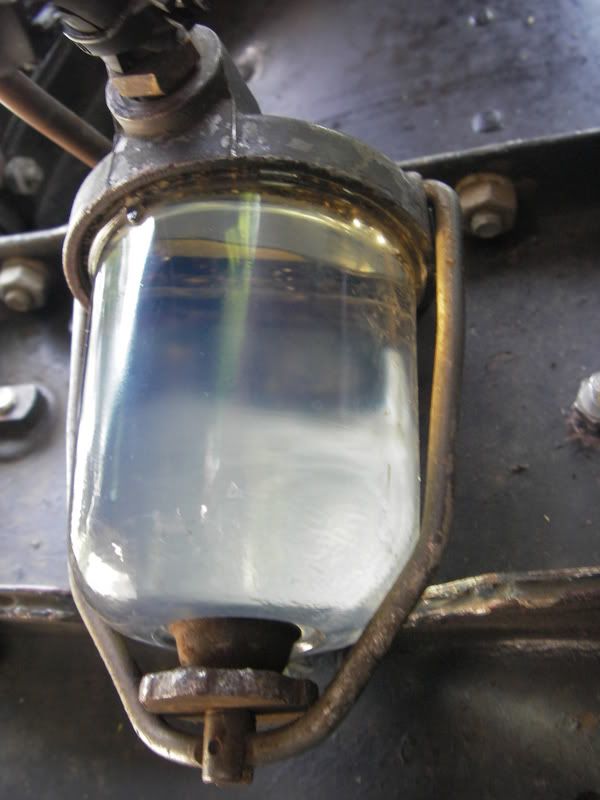 Here's another shot with the growing bubble covering most of the screen:  Here the bubble has completely covered the screen (sorry, not so clear photo). Shortly after this, the bubble suddenly blurps out the bowl outlet, down the line, to the carburetor: 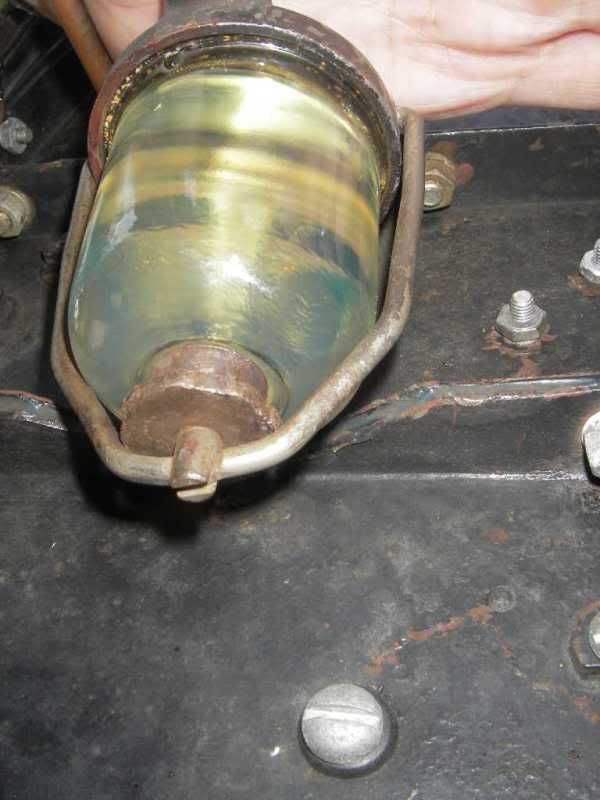 All the while during these photos, the motor ran normally. However, it's not hard for me to believe that under more severe conditions, similar vaporization could occur in the fuel line and the carb, eventually overwhelming the poor motor's ability to cope. Several years ago I experimented with a clear plastic in-line fuel filter that I spliced into the middle of the fuel line: I could watch with my own eyes as the filter filled up with vapor and stalled the engine--true vapor lock, in a gravity flow system being vibrated by a running motor! Sorry, that was before the days of digital camera and cheap photos. Also, I believe that the volumes involved establish that we are dealing with gasoline vapor here, not air. Steve Last edited by steve s; 05-27-2011 at 09:44 AM. |
|
|
|
|
05-27-2011, 11:33 AM
|
#50 |
|
Senior Member
Join Date: Aug 2010
Location: Lead. South Dakota
Posts: 963
|
Re: Vapor Lock 101 ?
If there is vapor in the carburetor, the float would be at the bottom and the needle valve would be wide open and let fuel flow. The vapor pressure can not be more than atmosphere pressure. The column of gas from the tank to the carb is above atmosphere pressure. Maybe turning the mixture needle in would male it run better. I remember the local hoodlums would run the fuel through a can of ice in their race cars. I think I would try one of the canned ice packs used for coolers or sprained wrists or fingers.
__________________
IF IT CAN NOT BE FIXED WITH BLASTING WIRE, JB WELD OR DUCT TAPE ---IT CAN NOT BE FIXED Do not get me started on the stupidity of ethanol. I think one of the monitors is from Iowa and he will delete the thread. |
|
|
|
|
05-27-2011, 01:42 PM
|
#51 |
|
Senior Member
Join Date: May 2011
Location: Carthage, NC
Posts: 147
|
Re: Vapor Lock 101 ?
Mountain Dew: Thanks for the exhortation for me to take off the blinders and think wider than vapor lock...I will go foreword with a more open mind!
MAG: Thanks for the link to gas stations w/o ethanol!...I learned there is one 15 miles from home in Sanford, NC...I will fill up my gas cans when I get up that direction next time. Mike V. Florida: Excellent list of things to look at... Engine Pan: Don't know about that aspect but I will say that the engine compartment seems hottest up near the firewall in the area of the sediment bowl...and this reminds me I should drain that and see what may be trapped in there. Also I should buy a thermometer and measure the temperature to I'm speaking with facts and data. I will say that when I put the hood up by the sediment bowl, it's so hot my skin starts burning in just 5 seconds...have to wear a glove if longer. Rad Flush: Good point. I aquired this 31 coupe a few months ago and have never flushed. I just drained 3 gallons out and it is really dirty! I filled it with fresh water and a quart of white vinegar to kick things off. I'll run that in there about a month then do the Simple Green flush. Plain water: Yes and there is no antifreeze mixed in. Steel or copper fuel lines: Steel Color of Plugs: Wow! I just pulled the plugs and they are really building up a thick layer of black soot. This is needs to be fixed. I have only run up about 50 miles since I got her. I run with the GAV tight. I checked the point gap and reset (the were way too tight). I noticed that the rotor tip swings below the 4 housing contacts. So I reshaped the brass by bending and filing down so I had .020" gap to the 4 contacts. Probably just a rabbit trail but I think the replacement rotor came from China if you know what I mean! In any event, since the plugs are black, I need to find the source of that and fix it. Maybe I should check the engine timing next? I've only driven it 50 miles so far but she always tends to pop when I back off the throttle fast explaining the too rich and black plugs. I'll go ahead and check the timing since I've already reset the points. By the way, I haven't had this much fun or a car that I could actually work on since I was a teenager! Fuel Filter: None...just the original sediment bowl (has been painted with silver paint along with the steel fuel line). How long driven before problem occurs: I drove it 4 miles to my nearest gas station where I filled it up to the filler neck ...thanks to Marc Hildebrandt for informing me to never fill it up all the way and to shut the engine off before adding any fuel! Vapor lock or whatever the problem is started immediately after pulling out of the gas station. Fuel Octane: 87 w/ 10% ethanol Fuel Brand: Unknown (The station is a "Kangaroo Express" which is common around this area.) I found the Ford Barn just a couple of days ago and it has helped me already more than words can ever express. Blessings to you one and all! |
|
|
|
|
05-27-2011, 03:59 PM
|
#52 |
|
Member
Join Date: Mar 2011
Location: Aiken, SC
Posts: 42
|
Re: Vapor Lock 101 ?
I'm fairly new to A's and have never seen vapor lock first hand. However, my experience studying liquid-vapor flows in laboratory settings leads me to believe that slope of that near-horizontal section beside the carb. would be fairly critical if bubbles are going to escape the carb. to the sediment bowl while the fuel is the opposite direction.
I just put a level on the fuel line of our A, and the section beside the carb is actually sloped up a little, as I would think it should to allow bubbles to escape. Has anybody checked the relative slopes of these lines on cars accused of vapor lock and those that are running well? |
|
|
|
|
05-27-2011, 07:11 PM
|
#53 | |
|
Senior Member
Join Date: May 2010
Location: Kalamazoo
Posts: 1,656
|
Re: Vapor Lock 101 ?
Quote:
Here's a picture of my fuel line showing its slope--taken just after I grasped at the insulation straw. 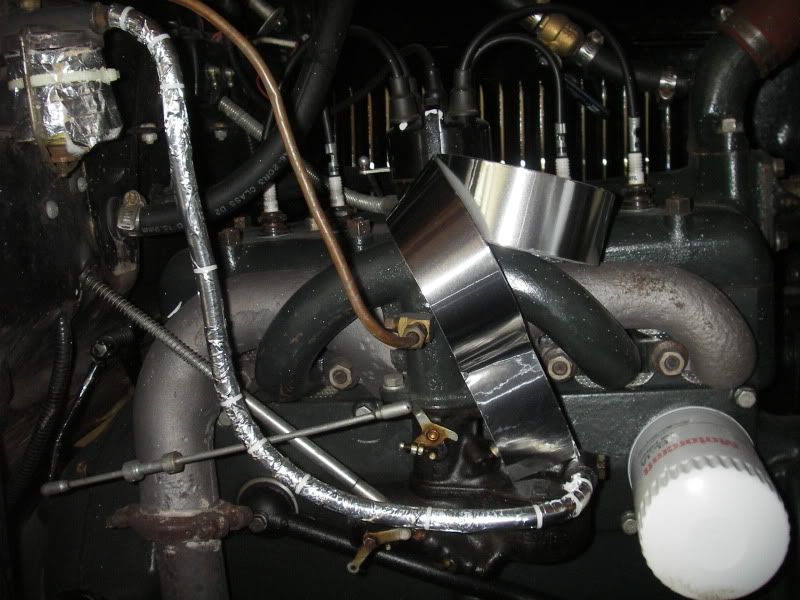 Steve |
|
|
|
|
|
05-27-2011, 11:36 PM
|
#54 |
|
Senior Member
Join Date: Aug 2010
Location: Lead. South Dakota
Posts: 963
|
Re: Vapor Lock 101 ?
do not forget to check the vent hole in the gas cap
__________________
IF IT CAN NOT BE FIXED WITH BLASTING WIRE, JB WELD OR DUCT TAPE ---IT CAN NOT BE FIXED Do not get me started on the stupidity of ethanol. I think one of the monitors is from Iowa and he will delete the thread. |
|
|
|
|
05-28-2011, 12:24 AM
|
#55 | |
|
Member
Join Date: Mar 2011
Location: Aiken, SC
Posts: 42
|
Re: Vapor Lock 101 ?
Quote:
I'm sorry. When I read this thread initially, your very clear point that you observed the bubble to exit toward the carburetor, and thus downhill, did not jump out at me as it should have. Thank you for bringing it to my attention and answering my question about your gas line slope thoroughly with the photo. My initial guess was that the Model A fuel line was a little too big to be fully obstructed by bubbles, but it looks like I was quite wrong. As I'm sure you are aware, a small tube will be obstructed by bubbles, held together by surface tension, yet in a large tube gravity will stratify the flow and allow countercurrent liquid and vapor flow. In the absence of substantial inertial or viscous effects, these tube sizes would be separated by a critical Bond number (http://en.wikipedia.org/wiki/E%C3%B6tv%C3%B6s_number). I just pulled out very long, clear drinking straw which I have measured as 5.5 mm inside diameter. As one might expect for drinking straw, I can suck water and air successively until the straw is filled with little plugs of water and air. This mimics the type of behavior that would allow a bubble to transit your fuel line downward. Interestingly, I can't do the same with denatured alcohol (ethanol) which has a somewhat lower surface tension. In terms of Bond number, the Model A fuel line (7.1) falls right between the ethanol in the straw (9.5) and the water in the straw (4.2). That's based on the first credible number that I found for the surface tension of gasoline from a journal paper published several years ago (http://www.sciencedirect.com/science...6943320400090X). In seems that ethanol blending reduces surface tension (http://dx.doi.org/10.1115/1.4003177), which I would presume is due to the same reasons that you nicely explained the vapor pressure. The reason that I go into all of this is that I believe what you describe is possible, but just barely so, raising interesting possibilities. A small difference in the inside diameter of the fuel line between cars or in the surface tension of the fuel could very much change the behavior in the fuel line. This might contribute to the mysterious distinction between vapor locking cars and non-vapor locking cars. -- Brian d'Entremont To clarify, for the Model A fuel line, I estimate: Bo=(730kg/m^3)(9.81N/kg)(0.00467m)^2/(0.022N/m)=7.1 Last edited by bdentremont; 05-28-2011 at 12:30 AM. |
|
|
|
|
|
05-28-2011, 09:00 AM
|
#56 | |
|
Senior Member
Join Date: May 2010
Location: Kalamazoo
Posts: 1,656
|
Re: Vapor Lock 101 ?
Quote:
As I stated earlier, when the vapor bubble passed, it barely caused the running motor to hiccup. The photos were presented as an example of vaporization, bubble formation, and bubble flow--not as an example of vapor lock, per se. My claim is that under actual vapor lock conditions--hot day, following a long pull, perhaps sitting a bit after turning off hot motor--it's not hard to imagine the harmless vaporization seen in the photos getting out of hand and causing a problem. I understand that the carb bowl is vented, but doesn't it make sense that in the limit of too much vapor and correspondingly too little liquid fuel coming down the fuel line, perhaps supplemented with vapor forming in the carb bowl itself, and perhaps further aggravated by "sticky" bubbles somewhere along the line, you could be in trouble? My problems showed up as needing to rev the engine as I pulled up to and sat at a stop light after a long pull; otherwise, the car would run very rough and die. Idling in the driveway was always fine, once things calmed down. Steve Last edited by steve s; 05-28-2011 at 09:11 AM. |
|
|
|
|
|
05-28-2011, 09:23 AM
|
#57 | |
|
Senior Member
Join Date: May 2010
Location: Kalamazoo
Posts: 1,656
|
Re: Vapor Lock 101 ?
Quote:
That's very interesting. The Bond number business is totally new to me. I like your speculation that subtle differences in the fuel line interior surface could be the culprit. It sounds sort of far fetched, but that's what we're reduced to, I think. It's consistent with my friend Dan's experience in which swapping carbs among cars that do and do not vapor lock did not make any difference. Would be an interesting experiment to swap the fuel lines. Also, if this is the case, it means my success with the new Zenith carb has nothing to do with the carb but with the fat rubber fuel line I had to use with it! Steve |
|
|
|
|
|
«
Previous Thread
|
Next Thread
»
 Linear Mode

|
|

| Sponsored Links (Register now to hide all advertisements) |
|
|
All times are GMT -5. The time now is 06:13 PM.