|
|||||||


| Sponsored Links (Register now to hide all advertisements) |
|
|
 |

|
Thread Tools | Display Modes |
 12-04-2010, 05:22 PM
|
#41 |
|
Senior Member

Join Date: May 2010
Location: Yucaipa, CA
Posts: 1,494
|
 Re: Restrictor washer instead of t-stat
This has been a great discussion. I’m now convinced that the restrictors will do more harm than good.
I keep a data base in my computer of flathead articles that have appeared in different hot rod publications from the past sixty-plus years. I remembered reading a story about installing restrictors and I was able to go into my data base and locate the article. In the October 1952 issue of Hot Rod Magazine there was a huge article on “How To Keep Your Engine Cool”, one section of the article was devoted to “Cooling Tips for Racing Engines”. I believe this article is the source of the restrictor myth. As this racing tip was past down from generation to generation of flathead enthusiasts somewhere along the way the part about it only being a modification for racing engines was omitted. Here is the racing part of the article, there is a lot of good info in it. Jerry “Cooling Tips for Racing Engines” During the search for information for this article, we put the “bee” on Vic Edelbrock, manufacturer of Edelbrock speed equipment, to see what we could gain from his years of experience with the cooling problems of competition engines. As usual, Vic had all the answers and was more than happy to cooperate. Vic began by discussing several factors of engine condition that can have a definite influence on the load carried by a cooling system. Lean fuel mixtures, for instance, resulting from carburetor metering jets of the wrong size, or from air leaks in the induction system, cause hotter than normal combustion temperatures and the transference of additional heat to the cooling system . Ignition timing that is too far advanced can cause detonation and increased cylinder temperatures. Retarded ignition timing fires the fuel in the cylinder when the pistons are on their way down on the power stroke and larger areas of the cylinder wall are exposed to combustion heat, thereby increasing heat transference to the cooling system. Late valve timing also exposes greater areas of the cylinder walls to combustion heat. Sharp edges, overhanging gaskets, and heavy carbon deposits in the combustion chambers can cause detonation and consequent high compression temperatures. Also, carbon deposits can act as an insulation between combustion gases and combustion chamber surfaces, increasing chamber temperatures and detonation tendencies. Spark plugs of a heat range hotter than that required can cause detonation. Exhaust back pressure cause by obstructed exhaust passages, inadequate manifolds, frozen exhaust damper valves or clogged mufflers or tailpipes can prevent exhaust gases from escaping freely from the cylinders and increases the quantity of heat transfer to the cooling system. Exhaust passages sometimes become partially obstructed when a core breaks while the block is being cast--an obstruction of this type can be chipped out of the passage with a chisel. Vic also discussed the subjects of correct cylinder head installation, which he considers one of the most important factors in the prevention of overheating; in-efficient water pumps; deteriorated water hoses; scale conditions, sometimes attributable to the addition of certain brands of stop leak to the system; pressure caps and their effect; thermostats and their action; and other subjects covered previously in this article. The method of testing the soundness of cylinder walls and intake and exhaust passages in engine blocks that have been bored, ported, and relieved was demonstrated with the equipment used in Vic’s shop for this purpose. The equipment consists of a steel plate cut to fit the top of a cylinder block, with openings over the cylinders and around the valves, and an adaptor for connecting an air hose to the water inlet on the water pump. The block is checked by bolting the plate to the block with a suitable had gasket to seal water openings in the top of the block and then increasing the pressure in the water camber to 10 to 15 pounds per square inch with air from the air hose. With pressure in the block, leaks are readily located by applying a solution of soap and water to the cylinder walls and intake and exhaust passages with a brush. The detrimental effects of combustion leaks through the cylinder or passage walls have already been discussed; if any leaks are found that cannot be repaired, the block should be discarded. Boring cylinders to large oversizes can add to overheating difficulties if the walls become so thin that they distort under pressure and permit combustion gases to blow by the rings and pistons. Engines assembled with inadequate clearances between their moving parts can create sufficient heat from internal friction to cause overheating. Cooling System Modifications for Track Racing Vic’s observations of cooling system improvements for Ford V8 and Mercury engines used for track racing proved to be especially interesting. At one time these engines were considered practically impossible to cool when used for track competition, but methods have since been devised whereby cooling troubles can be eliminated in practically all cases by making minor changes to the system. A common fault of automotive engines converted for racing is the tendency of the water pumps to pump much more water at high speeds than is actually needed to cool the engine. When this occurs water is pumped out the radiator overflow because the water cannot flow through the radiator core as fast as it is pumped into the upper radiator tank. A Ford V8 or Mercury pump can be modified to reduce its pumping capacity by removing three of the six vanes from its impellor and drilling a 5/16 inch diameter hole in each remaining vane. The treatment doesn’t leave much of the impellor to circulate the water, but little is needed at high pump speeds. Then, too, the natural thermo-siphoning tendency of the hot water in the system to rise and flow toward the outlet in the cylinder heads is almost sufficient in itself to cool the engine. The thermostat in each cylinder should be left in place or replaced with a restrictor washer with a hole approximately 5/8 inch in diameter in the center. Restriction to water flow provided by thermostats or restrictor washers also aids in preventing water loss through the overflow pipe. Water circulation through the cylinder blocks can be improved by blocking the upper two water holes in the center of the block directly over the center exhaust passage. Blocking these holes with thin piece of brass shim stock placed between the block and head gasket forces the water to travel to the rear section of the block before it can escape to the cylinder head. Circulation in late model Ford V8 and Mercury blocks has been modified along these lines by changes in head gasket design. Best results have been had with radiator cores that provide the maximum possible frontal area. The design of the radiator shell will limit the size of the core that can be used, but full advantage should be taken of every available square inch of space. Core thickness of 3 to 3 ½ inches is considered the practical maximum for efficient cooling. Radiators should be installed so that hoses between the outlets fittings in the heads and the radiator inlets have at least a slight rise through out their length, with the radiator inlets above the engine outlets. If the radiator end of a hose is lower than the engine end, or if any part of the hose is higher than the outlet end, it is possible for a steam pocket to form at the high spot in the hose and effect circulation of the water. The radiator should be situated that air flow through the core in not restricted. This shouldn’t pose too great a problem in cars built for track racing unless a fancy grille is used in the radiator shell. Vic found by experimentation that the installation of a seemingly plain grille over the radiator of his V8-60 midget raised the engine’s operating temperature 15 degrees, sufficient to mean the difference between a passable temperature and overheating. Another of Vic’s discoveries was that ordinary window screen mounted on a suitable frame made a better “shaker” screen than the ¼ inch mesh hardware cloth ordinarily used. Shaker screens are mounted in front of the radiator when racing on dirt tracks to catch dirt and mud particles before they clog the radiators air passages. The screens are loosely mounted, or suspended on springs, so they can move in relation to the chassis and literally shake themselves clean while the car is moving. But despite the shaking action, dirt and mud have a tendency to become lodged in the mesh of the hardware cloth and stick, while the finer mesh window screen, by not having openings large enough for the mud to become lodged in, stays clean. Vic mentioned something else that is often overlooked in track and lakes cars, and that is the fact that although many precautions are taken to get air through the radiator, many times a means is not provided for getting air out of the engine compartment after it has gone through the radiator. This means that the engine in a constant bath of heated air, and fresh air flow through the radiator is restricted by the air trapped in the engine compartment. The cure for a condition of this type is to ventilate the engine compartment by removing some of the sheet metal surrounding the engine or by cutting many louvers in the metal. The wrong rear axle ratio for existing track conditions can cause engine overheating if it causes the engine to be lugged or over-revved. Ratio that is too high will overload the engine, while with a ratio that is too low, the engine will over-rev. |

|

|
|
12-04-2010, 05:36 PM
|
#42 |
|
Senior Member

Join Date: May 2010
Location: Tyler Texas
Posts: 226
|
Re: Restrictor washer instead of t-stat
Just my 2cents I run t-stats.The one on the lift bank openes about 165. the right side opens about 170. the temperature never goes above 185. Model A radiator that I modified to a flathead.Blocked off the center return and used a junk 52 ford radiator return pipes. Built a right side lower pan with suction pipe.using the lower tank right side of the 52 radiator. Rodded out the A radiator with long mig welding rod.So fare so good. It my be that the T-stats restrict the return flow loke a washer. It works and as long as it do I will leave it alone. Lyle
|
|
|
|
| Sponsored Links (Register now to hide all advertisements) |
|
|
|
12-04-2010, 05:38 PM
|
#43 |
|
Senior Member

Join Date: Oct 2010
Location: Orem, Utah
Posts: 5,781
|
Re: Restrictor washer instead of t-stat
It sure looks like the old "less water flow is better" myth has been pretty well busted.
__________________
Prof. Henry (The Roaming Gnome)  "It is good to have an end to journey toward; but it is the journey that matters, in the end.” *Ursula K. Le Guin in The Left Hand of Darkness |
|
|
|
|
12-04-2010, 08:56 PM
|
#44 |
|
Senior Member

Join Date: May 2010
Location: PASADENA, CA
Posts: 1,962
|
Re: Restrictor washer instead of t-stat
WOW;
Lots of opinions on how to keep a flathead cool. I might as well put in my feelings on then subject. First of all, the exhaust ports run from the top to the engine clear thru the water jackets and out the bottom. This is not the optimum design for a cool running engine. With this design, the Ford Flat Head V-8 makes an excellent water heater. We can not do much about this unless we would want to completely re-configure the exhaust flow thru the engine which is not practical. Secondly, The water flow thru the engine is not a good design. The early Flat Heads had the water pumps high up on the heads. They pulled hot water from the engine and pushed it up into the top of the radiator. This arrangement lead to cavitation and very inefficent pump operation. The water also entered the engine at the front and exited the engine at the front. There was little to "encourage" the water to circulate back thru the rear of the engine and the rear cylinders would run hotter then the others. Later, when the pumps were installed on the bottom front of the engine, the pumps worked better and the "Center Outlet" heads did improve the flow thru the block to some degree but the rear of the engine still suffered from inadequate circulation. When the Hot Rodders started hopping up these engines, they ran hotter and during hot wether or hard usage, the poor circulation to the rear of the block would cause the water around the rear exhaust port to get hot and want to flash to steam. When these "steam pockets" would form some of the coolant was displaced and the car would want to "Boil Over". On engines where the water pumps are installed on the front of the block, adding restrictors to the outlets on the heads will actually raise the coolant pressure in the block when the engine is running at speed. The smaller the restrictor, the greater the pressure required to flow coolant thru it. This increase in pressure will cause the coolant to boil at a higher temperature and thus delay the forming of steam pockets. Too small of restrictor will not allow enough coolant to flow thru the engine and it will run hot just because of inadequate coolant flow. Too big of a restrictor will not increase the pressure adequately to reduce the formation of steam pockets. Thru experience, it seems a 5/8 to 3/4 in. restriction is just about optimum. A better way to keep a flat head running cool is to improve the circulation to the back of the block. One of the cleveriest ways to do this I ever saw was a guy with a '37 21 stud engine had the water pumps in the front of the block and put '36 heads on it BACKWARDS so the water exited at the rear of the engine. He custom made water pipes to get the coolant from the back of the head to the upper outlets on the engine. The coolant entered the engine at the front and exited the heads at the rear. This greatly improved circulation thru the engine. There were some aftermarket hanufacturers that made heads with water manifolds that drew water from the head at the front, center and rear. This system worked well. I have had success by installing a piece of 3/8 in copper tube down thru the center outlet in the head and fishing it back inside the head toward the upper rear corner. I install a disc (restrictor) with two 3/8 in holes in the water outlet in the head, one hole for the copper tube and one for coolant to pass. The copper tube terminates about an inch or so ABOVE the disc. Because of this restriction, at speed, there is a pressure drop across the restrictor due to the higher pressure in the block then the upper radiatror hose. This pressure drop will cause coolant to flow thru the copper tube and thus coolant flow to the rear part of the block is improved. It works out that about 1/3rd of the total coolant flowng thru the engine will flow thru the copper tubes and about 2/3 rds will flow thru the second 3/8 hole in the restrictor. Some additional benifite is obtained by also installing 1/2 in. copper tubes in the from the water pump outlet area in the front of the block thru bottom of the water jackets toward the rear. This also helps promote circulation to the rear of the block. Some "Racers" do this same type of "Plumbing" on the exterior of the block with good success but I did not want my modifications to show when finished. The result of doing this on a mildly modified 59AB in a A-V8 Hot Rod, with an original '32 re-cored radiator (no pressure cap) and a stock '32 fan, was the car ran too cool. The car would run at about 140-150 Deg running down the road as long as temps were less then about 90 deg. It may get up to 160 with 100 Deg outside temps. On cool days, it would want to run at about 120 Deg. I finally installed thermostats and the car now runs at 160 deg. almost all the time. Sorry for being so long winded BUT think about how the water flows thru the engine and the need for increased pressure of the coolant to reduce the formation of steam pockets. This is what worked for me. Chris |
|
|
|
|
12-04-2010, 11:39 PM
|
#45 |
|
Senior Member
Join Date: May 2010
Location: Florida and Penna.
Posts: 4,471
|
Re: Restrictor washer instead of t-stat
Chris I would love to see the 32 that ran at 160 when it was 100 out with an "A" radiator and no pressure cap with a open over flow. I would check the temperature gauge. G.M.
__________________
www.fordcollector.com |
|
|
|
|
12-05-2010, 12:36 AM
|
#46 |
|
Senior Member

Join Date: May 2010
Location: Sweden
Posts: 427
|
Re: Restrictor washer instead of t-stat
Sponsored Links (Register now to hide all advertisements)
In my opinion Ignition advance is the most important thing to checkout, not enough advance will raise the temperature to boiling point and above. So i add my own TDC indicator to be able to check ignition advance on the enginte running. |
|
|
|
|
12-05-2010, 08:29 AM
|
#47 |
|
Senior Member
Join Date: May 2010
Location: Florida and Penna.
Posts: 4,471
|
Re: Restrictor washer instead of t-stat
MR 42 Modern cars are required to run at higher temperatures for polution and the way fuel system is designed. There are no modern thermostats made that I know of that will work on 32 to 48 Ford engines. All of the modern stats have a flow opening of much less than 1". This will work at temperatures below about 60 degrees and is nessesary if driving in cold temperatures. But when the temperature gets up in the middle 80s the restriction of the flow causes the engine to run up in the 190 plus range. This happens even with 160 degree thermostats. I drilled 8 .125 holes in the flange of Nappa # 111 stats and they worked a little better but still when it got over 90 outside the temperature went to 190. At 190 if you get in heavy stop and go traffic or sit at idle for a few minutes the temperature climbs up where you can't see what the temperature is on the liquid type gauge. Although it may not boil over I get very uncomfortable when it gets that high. Most people don't drive these cars in cold weather and on the few days when it gets in the 60 range a piece of cardboard over the bottom 1/3rd of the radiator works fine. If driven in cold weather then thermostats are required and will work in cold weather but must be removed when it gets hot out. If thermostats really work the way they should a 160 or 170 stat would keep the engine at the rateing of the stat even in hot weather. Look and see what your ? 170 stats do to the temperature when it gets 180 out. G.M.
__________________
www.fordcollector.com |
|
|
|
|
12-05-2010, 09:49 AM
|
#48 |
|
Senior Member
Join Date: May 2010
Location: Sweden
Posts: 427
|
Re: Restrictor washer instead of t-stat
If i remember right car manufacturer have added thermostats since the thirties, so i think you should be able to get the orignal type if you want.
I dont think you can buy OEM restrictor plates. I have Peugeot 206 1993-1999 thermostat's in my 59AB, and even if i live in Sweden we get days up around the 100 F. And i have driven my car on those days with out problem.Even in heavy traffic. 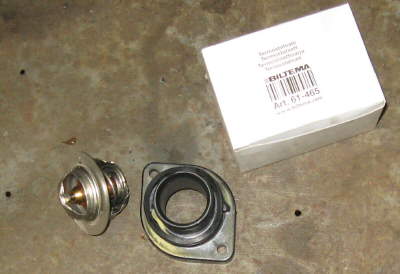 It opens at 89 Degrees celsuis 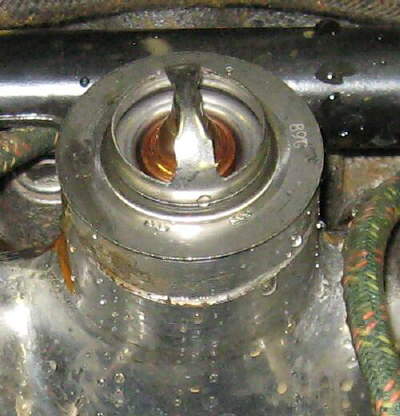 I drilled a 3mm hole to get air out of the system when filling up and the engine is cool, not to improve flow 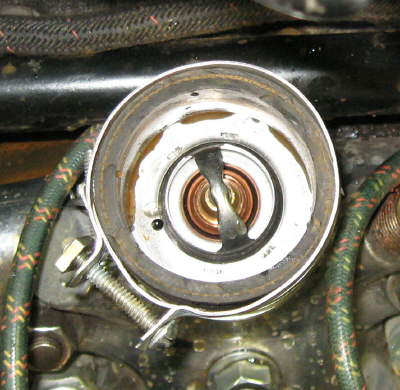
Last edited by Mr 42; 12-05-2010 at 09:57 AM. |
|
|
|
|
12-05-2010, 01:20 PM
|
#49 | |
|
Senior Member
Join Date: May 2010
Location: PASADENA, CA
Posts: 1,962
|
Re: Restrictor washer instead of t-stat
Quote:
When I originally got this car running about 5 years ago, it had an old worn out 59-AB engine in it that was full of rust and an old aftermarket '32 radiator with a honeycomb core that did not cool at all. The car would always run hot nad want to boil over and I had to carry extra water with me where ever I went. About 4 years ago, I built a new engine for the car and re-cored the radiator. The Radiator is an original '32 that was re-cored with a high effency core. I had a very clean block and I run Distilled water and Purple Ice. Open system with no pressure cap or pressure recovery. I used stock water pumps that I rebuilt myself. I also run some vintage race cars and we are always are confronted with overheating. On car that was a particular problem was a 1953 Road Race Car with a GMC 302 Engine with a Wayne 12 Port Cross Flow head. The previously owner complained that no matter what he did, that engine always ran hot. There were two basic problems, First, the water pump was originally sized for an engine with about 150 HP and would not flow enough water for an engine that was putting out more then twice that ammount. The second basic problem was that the water entered and exited the front of the engine and there was little to cause good circulation to the rear of the engine. To overcome this, I "built" a new pump using SBC aftermarket pump internals which would flow several times what the original GMC Pump would. I also tapped into the rear of the head and made up a water return line so as to take water from the rear of the engine and return it to the top of the radiator. About half of the coolant flow comes from the rear of the head and the rest from the front. The end result was that on cool days, we have to tape up part of the radiator to get enough heat into the engine for it to run right and on the very hot days, we are able to maintain a temperature of about 180-190 Deg. under racing conditions From this experience, I looked at how to get better flow thru the Flathead. I also got some clues from reading an old artical written by Barney Navarro where he talkes about putting copper tubes within the block to improve circulation. I put this engine together about 4 Years ago and used the Roadster extensively to pre-run the Pasadena Roadster Clubs Reliability Runs. I was ammazed as to how much cooler the car ran. I did a customer engine about a year later with the same results. Please understand, I am not saying other ideas do not have marit, I am just relating my experience. If you are ever out my way, come by an dI will take you for a ride. Chris |
|
|
|
|

|
12-05-2010, 01:28 PM
|
#50 | |
|
Senior Member
Join Date: May 2010
Location: PASADENA, CA
Posts: 1,962
|
Re: Restrictor washer instead of t-stat
Quote:
Chris |
|
|
|
|
|
12-05-2010, 01:35 PM
|
#51 | |
|
Senior Member
Join Date: May 2010
Location: PASADENA, CA
Posts: 1,962
|
 Re: Restrictor washer instead of t-stat
Quote:
Proper Ignition timing and a correct advance curve is something a lot of people miss. Timming by ear is not nearly as good as being able to ues a TDC Mark and a good timming light. Chris |
|
|
|
|
|
12-05-2010, 07:08 PM
|
#52 |
|
Senior Member
Join Date: May 2010
Location: Florida and Penna.
Posts: 4,471
|
Re: Restrictor washer instead of t-stat
Henry when we started testing we took the temperature at the top of the heads where the hoses are or on the water outlet on the 36 type pumps plus the top of the radiator the center of the radiator and the bottom tank also the center of the heads and the rear of the heads. At some point we took the temperatures on the the head on each cylinder just below where it dips down for the spark plugs. We ran all tests for 30 minutes with a large fan against the radiator, this simulates driving down the road and I would say engine speed was in the 45 to 50 MPH range. Once the temperature stabilizes for 10 or 15 minutes meaning it gets to say 175 degrees and don't go any higher it will run all day at that speed at this temperature. The temperature in the center of the radiator was lower then the top and even lower at the bottom tank. If I recall the bottom was on the 145 range. After a 100 or more tests we came to the conclusion the only temperature that is important is at the head outlet and that both sides are within a few degrees of each other. The other temperature of importance is in the very center of the heads between 2 and 3 and 6 and 7 which gets hotter then the back of the heads. Almost all diesel engines have a problem with pin holes in the cylinders IF AN ADDITIVE LIKE Purple Ice is not used. Infact the warrantee is void if not used. Go to a Ford truck forum and find the results. What happens is in certain internal areas the surface gets small air bubbles attached to the surface. This insulates the surface from the water creating hot spot and the oxygen in the bubbles causes the pin holes from what I read. Purple Ice coats the surface and eliminates or greatly reduces the hot spots. When I first thought the problem looked like the same as what I read about diesels I bought 2 bottles of PI. We had run 10 or 12 tests on the 33 and after 20 minutes with fan at the grill it would get to 229 and spit over a gallon water out everytime driving it the same thing happened that's why we got into the testing. After lunch I put the 2 bottles of PI in and started it up, it went up to 216 then 217 and I thought "SH##" that was a waste of $18.00. It didn't keep going up as it did on all the other tests it sat a 217 for about 5 or 10 minutes then started to slowly drop to 207. I was watching close with the laser pointed thermometer as it came down. After that when we ran it it would stay at 207. That's when we made the first pump and it came down in the normal range on one side and still up near 207 on the other side. Swapped pumps and the cold and hot side changed as stated in another post. G.M.
__________________
www.fordcollector.com |
|
|
|
|
12-05-2010, 07:23 PM
|
#53 |
|
Senior Member
Join Date: May 2010
Location: Florida and Penna.
Posts: 4,471
|
Re: Restrictor washer instead of t-stat
Frank before coating the surface it would have to polish it. The top plate, tubes and solder are not shiny and polished after a radiator is built or recored, It is dull and has an acid etched look. If I recall when I had the pumps off the block looked brand new inside. This was a brand new block when I put it in the 39 over 30 years ago, the heads were also new. I'm not going to pull the pumps but sometime this week I will drain the water down some and get my son inlaw who is a professional photographer to come over and take some good pictures down in the radiator and in the heads and post them. I believe the Barrs bottle states it helps prevent electrolisis also. Probly the PH in the coolant if controled would help?? G.M.
__________________
www.fordcollector.com |
|
|
|
|
12-05-2010, 07:37 PM
|
#54 |
|
Senior Member
Join Date: May 2010
Location: Florida and Penna.
Posts: 4,471
|
Re: Restrictor washer instead of t-stat
Mr 42 you need to post specific temperature readings. Just a statement "without problem" don't say much. A problem to some may be different from a problem to others. If the coolant temperature on a 95 degree day gets in the 190 plus range driving and you get in heavy stop and go traffic it don't take long to get over 200. I like a larger safty margin. To a lot of people it's not a problem until it boils over.This is how these cars have been operated on the large part for over 60 years. G.M.
__________________
www.fordcollector.com |
|
|
|
|
12-05-2010, 09:27 PM
|
#55 |
|
Senior Member

Join Date: May 2010
Location: ManchVegas, New Hampshah
Posts: 1,591
|
Re: Restrictor washer instead of t-stat
I went through this chase last summer after experiencing a boil over on a tour. The ambient temperature was 95°F +. The following are actual temperature measurements taken before and after replacing water pumps to cure a low speed over heat problem. There was no over heat problem when moving faster than 20 MPH. The vehicle is a ’41 pickup with a 59ab engine dual carbs (running 1 at the time) dual exhaust, stock 3 speed, and 3:54 gears. No restrictors or thermostats are installed. I have not run in as high ambient temps since making the pump change. The high flow pumps did make a reduction in engine temp. What remains for me to figure out is if there is adequate air flow through the radiator on a 95°F + day to prevent a boil over. I believe the crank mounted fan either needs a shroud or a helper fan at slow speeds. I am not yet convinced I am done with this issue.
Temp measurement results: Stock pumps: First 20 min. flush with Cascade run this morning (old pumps): Ambient temp 68° engine temp 174°. Cascade did something. The dumped water was cappuccino brown. Second 20 min rinse cycle with only water: Ambient temp 78° engine temp 185°. The dump water was the same color but you could see through it. Removed pumps and radiator. Reversed flushed radiator. Saw clear water and good flow. Checked the oil passages (were good) and installed pumps and radiator. New “Improved” pumps: Filled the system with water only and went on the 20 min. cycle. Ambient 80° engine temp 165° I am using a Craftsman DVM with a thermocouple input to take the engine temp readings. I take the reading at the hose connection on the heads. Both sides are within 5°. Here are the temp readings with the recommended coolant mix. That is 2 gallons of Texaco antifreeze, 2 16 oz bottles of Purple Ice, 1 16 bottle of pump lube and corrosion inhibiter (I used a Solder Seal Product) and the Barrs stop leak. Ambient temp 76° Coolant temp 160. This pretty much matches the straight water readings after the pumps were installed. The change to the high flow pumps decreased the engine temp rise by 20°F. Last edited by 41ford1; 12-05-2010 at 09:29 PM. Reason: fix format |
|
|
|
|
12-06-2010, 02:16 AM
|
#56 |
|
Member
Join Date: Jul 2010
Location: Topanga CA
Posts: 36
|
Re: Restrictor washer instead of t-stat
One of the things that frequently gets missed in this traditional cooling system discussion is the end use of the vehicle. The conditions of a street cruiser in Vegas are very different from those of a road racer.... and the car's use must be specified or else something that is a very good idea for one driver will be dismissed as nonsense by the other.
An example is changing the pulley ratios for a street driven car to increase the water speed and volume at low rpms...giving the same result as a "high performance pump" for the cost of a pulley. Or equally, changing the pulleys for a road race car to slow the waterpumps and keep them from being overdriven and cavitating. I'm learning everything goes to hell when a waterpump impeller exceeds 7000rpms. I believe the "myths" about restrictor discs and "grinding off every other vane" originated from problems that occurred when roadracing stock cooling systems at continuous high rpms and forcing the caps - which for a long time were located on the radiator itself or more recently on a tank in the "pump-out" side of the system - to open from water pressure (not heat) and lose coolant, which then caused overheating. Slowing the water flow (pressure) by laming the pump and/or restricting the flow kept the water in the system and that kept things cool. Now that we have figured out that what we really want is an overflow tank/cap on the "return" side of the system where the cap can't be exposed to sudden slugs of high-pressure pumped water, we can block off all other caps and run a high-pressure pump and a very high pressure cap if we like. They didn't get that far back then. But back in the day, with a 4# cap on the radiator and no overflow tank, I'll bet the boys running 'shine at 5000 rpms ground off those pump vanes and stuck those restrictor washers in there because it worked. |
|
|
|
|
12-06-2010, 08:55 AM
|
#57 |
|
Senior Member
Join Date: May 2010
Location: Florida and Penna.
Posts: 4,471
|
Re: Restrictor washer instead of t-stat
41 it sounds like you got things under control driving down the road in any temperature with the forced air from forward motion. The fan limits very slow speed and long idles. The only solution is more air at Idle like my 39 P/U with a 6 bladed fan and shrowd. I'm not convince all electric fan help these cars. Infact the several I checked for friends with electric fans were worce. I drive my 39 convertible for over 1,000 miles trips in temperatures 100 or over and it runs at 180 at speeds up to 75 MPH. When it's that hot I have to be careful of prolonged idles and never let it get over 200.
Andy with the high volume pumps there is no noticeable increase in pressure, the possitive drive turbine impellers don't slip or spin in the coolant like the paddle wheels. The coolant is smoothly pushed and much less or almost no air is stirred into the coolant. At 200 degrees with these pumps the pressure in the radiator is about 1-1/2 lbs.so a 4 lb cap is all that is required. My findings are mostly on stock Fords with a stock radiator. When it gets into a lot of chassis, engine, sheet metal and radiator modifications we are not dealing with know factors. A lot of modifieds are using the modified pumps with good results but It's hard to sit at a computer or talk on the phone and solve unknown issues. G.M.
__________________
www.fordcollector.com |
|
|
|
|
12-06-2010, 10:40 PM
|
#58 |
|
Senior Member

Join Date: May 2010
Location: Camarillo, CA and Pine Grove, CA
Posts: 3,017
|
Re: Restrictor washer instead of t-stat
There was mention here about where to get a pressure valve that fit on the overflow tube. It seems to have disapeared. Where can I buy one?
__________________
1921 Runabout 1930 Tudor Early 1930 AA Speed costs money. How fast do you want to go? 
|
|
|
|
|
12-07-2010, 12:13 AM
|
#59 | |
|
Senior Member
Join Date: Oct 2010
Location: Orem, Utah
Posts: 5,781
|
Re: Restrictor washer instead of t-stat
Quote:
Contact Skip Haney 941-637-6698 day or 941-505-9085 nites. [email protected]
__________________
Prof. Henry (The Roaming Gnome) "It is good to have an end to journey toward; but it is the journey that matters, in the end.” *Ursula K. Le Guin in The Left Hand of Darkness |
|
|
|
|
|
12-07-2010, 08:48 AM
|
#60 |
|
Senior Member
Join Date: May 2010
Location: Florida and Penna.
Posts: 4,471
|
Re: Restrictor washer instead of t-stat
Henry you have Skips information correct but the pressure valve is 3 lbs. It also is NOT INTENDED to increase the boiling point. Increaseing the boiling point is not a factor on the old Fords. Properly cooled the coolant temperature will never get to 212 degrees. The 3 lb valve or 4 lb pressure will release the pressure just before the coolant boils. When the coolant gets to 200 your close to having problems. The idea is to never let it get over 200 and if you get in heavy traffic with one of these cars with a boarder line performing fan you have to get moveing so the forced air cools the coolant. With a 4 lb pressure cap or the 3 lb valve and high volume water pumps the temperature will come back in the normal in about 1 mile. G.M.
__________________
www.fordcollector.com |
|
|
|
|
«
Previous Thread
|
Next Thread
»
 Linear Mode

|
|

| Sponsored Links (Register now to hide all advertisements) |
|
|
All times are GMT -5. The time now is 02:54 PM.