|
|||||||


| Sponsored Links (Register now to hide all advertisements) |
|
|
 |

|
Thread Tools | Display Modes |
|
|
 05-24-2011, 08:50 PM
|
#1 |
|
Senior Member
Join Date: May 2010
Location: Kalamazoo
Posts: 1,656
|
 Re: Vapor Lock 101 ?
[QUOTE=Mountain Dew;213610 ... Why would an air pocket stop the gas flow? There are no loops or high spots in the fuel line. Why doesn't the air pocket rise to the top of the fuel tank?[/QUOTE]
Bubbles can be sticky. Did you ever have to jiggle the sink stopper to burp the drain and get it to drain? It doesn't help the bubble rise when the liquid it's trying to flow thru is moving in the opposite direction. Steve |

|

|
|
05-24-2011, 10:39 PM
|
#2 |
|
Senior Member

Join Date: May 2010
Location: Newport, NC
Posts: 200
|
Re: Vapor Lock 101 ?
[QUOTE=steve s;213693]Bubbles can be sticky. Did you ever have to jiggle the sink stopper to burp the drain and get it to drain? It doesn't help the bubble rise when the liquid it's trying to flow thru is moving in the opposite direction.
A Model A engine provides an ample amount of jiggle to dislodge a bubble from a gas line. I'm sorry guys, I not buying any of the vapor lock theories. Vapor lock has never happened to me and it never will because I don't believe in it. I have had a faulty condenser and trash in the fuel tank cause my Model A to act like you described. Since I was sceptical, I looked at other things to find the problem and not write it off as the vapor lock mystery. I don't think you will find a cure for your vapor lock. I think you can find out why your Model A is not performing like it should. Good Luck!!!! |
|
|
|
| Sponsored Links (Register now to hide all advertisements) |
|
|
|
05-24-2011, 11:06 PM
|
#3 | |
|
Senior Member
Join Date: May 2010
Location: Newport, NC
Posts: 200
|
Re: Vapor Lock 101 ?
Quote:
Nope.....That's hocus-pocus, salami salami bolonie just like vapor lock. LOL 
|
|
|
|
|

|
05-25-2011, 01:11 PM
|
#4 |
|
Senior Member

Join Date: May 2010
Location: NC
Posts: 2,975
|
Re: Vapor Lock 101 ?
We can call it what we like, but my Model A starts running ruff and does not want to idle when the temp gets above 85 after it sits for a spell when hot. After you drive a while it is ok. Just got back with my 56 chev I have to use the electric fuel pump when I first start it afer it sits when hot. It did it today a couple of times, temp is in the 90ts. This happens every year when it is hot out side. It did not use to do this before the crap gas.
You know we call engines- motors, ships- boats, brake shoes- brake pads. What is so bad about calling gas vapor, vapor lock. |
|
|
|
|
05-25-2011, 01:54 PM
|
#5 |
|
Senior Member
Join Date: May 2010
Location: Central Highlands, Cen~Col
Posts: 2,896
|
Re: Vapor Lock 101 ?
Disclaimer # 347 :Swallow your beer before reading this.
Let's just call it " SOBDontRunRightItus" from now on and avoid all the naysayers who say that vapor lock can not exist in Model As! 
Last edited by Benson; 05-29-2012 at 03:29 PM. |
|
|
|
|
05-25-2011, 04:45 PM
|
#6 | |
|
Senior Member
Join Date: May 2010
Location: Mpls, MN
Posts: 27,582
|
Re: Vapor Lock 101 ?
Sponsored Links (Register now to hide all advertisements)
Quote:
 Years ago I also thought vapor lock couldn't happen in a gravity feed fuel system. Then One day I was riding in my friend's Model A when the engine dies as he slows to make a turn. It happened several times that day whenever he slowed down or stopped. Then when I started driving my Model A I experienced the same thing, until I started paying more for the good gas. Call it what you want, but to me it's vapor lock and so far has only happened when I use the crap gas and the temp is above about 80*. Then when I started driving my Model A I experienced the same thing, until I started paying more for the good gas. Call it what you want, but to me it's vapor lock and so far has only happened when I use the crap gas and the temp is above about 80*.
|
|
|
|
|
|
05-27-2011, 03:59 PM
|
#7 |
|
Member
Join Date: Mar 2011
Location: Aiken, SC
Posts: 42
|
Re: Vapor Lock 101 ?
I'm fairly new to A's and have never seen vapor lock first hand. However, my experience studying liquid-vapor flows in laboratory settings leads me to believe that slope of that near-horizontal section beside the carb. would be fairly critical if bubbles are going to escape the carb. to the sediment bowl while the fuel is the opposite direction.
I just put a level on the fuel line of our A, and the section beside the carb is actually sloped up a little, as I would think it should to allow bubbles to escape. Has anybody checked the relative slopes of these lines on cars accused of vapor lock and those that are running well? |
|
|
|
|
05-27-2011, 07:11 PM
|
#8 | |
|
Senior Member
Join Date: May 2010
Location: Kalamazoo
Posts: 1,656
|
Re: Vapor Lock 101 ?
Quote:
Here's a picture of my fuel line showing its slope--taken just after I grasped at the insulation straw. 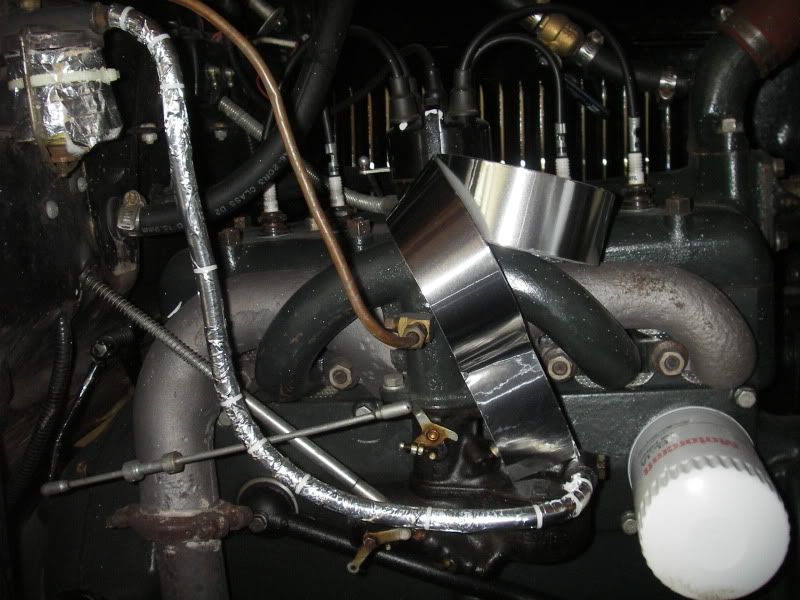 Steve |
|
|
|
|
|
05-28-2011, 12:24 AM
|
#9 | |
|
Member
Join Date: Mar 2011
Location: Aiken, SC
Posts: 42
|
Re: Vapor Lock 101 ?
Quote:
I'm sorry. When I read this thread initially, your very clear point that you observed the bubble to exit toward the carburetor, and thus downhill, did not jump out at me as it should have. Thank you for bringing it to my attention and answering my question about your gas line slope thoroughly with the photo. My initial guess was that the Model A fuel line was a little too big to be fully obstructed by bubbles, but it looks like I was quite wrong. As I'm sure you are aware, a small tube will be obstructed by bubbles, held together by surface tension, yet in a large tube gravity will stratify the flow and allow countercurrent liquid and vapor flow. In the absence of substantial inertial or viscous effects, these tube sizes would be separated by a critical Bond number (http://en.wikipedia.org/wiki/E%C3%B6tv%C3%B6s_number). I just pulled out very long, clear drinking straw which I have measured as 5.5 mm inside diameter. As one might expect for drinking straw, I can suck water and air successively until the straw is filled with little plugs of water and air. This mimics the type of behavior that would allow a bubble to transit your fuel line downward. Interestingly, I can't do the same with denatured alcohol (ethanol) which has a somewhat lower surface tension. In terms of Bond number, the Model A fuel line (7.1) falls right between the ethanol in the straw (9.5) and the water in the straw (4.2). That's based on the first credible number that I found for the surface tension of gasoline from a journal paper published several years ago (http://www.sciencedirect.com/science...6943320400090X). In seems that ethanol blending reduces surface tension (http://dx.doi.org/10.1115/1.4003177), which I would presume is due to the same reasons that you nicely explained the vapor pressure. The reason that I go into all of this is that I believe what you describe is possible, but just barely so, raising interesting possibilities. A small difference in the inside diameter of the fuel line between cars or in the surface tension of the fuel could very much change the behavior in the fuel line. This might contribute to the mysterious distinction between vapor locking cars and non-vapor locking cars. -- Brian d'Entremont To clarify, for the Model A fuel line, I estimate: Bo=(730kg/m^3)(9.81N/kg)(0.00467m)^2/(0.022N/m)=7.1 Last edited by bdentremont; 05-28-2011 at 12:30 AM. |
|
|
|
|
|
05-28-2011, 09:23 AM
|
#10 | |
|
Senior Member
Join Date: May 2010
Location: Kalamazoo
Posts: 1,656
|
Re: Vapor Lock 101 ?
Quote:
That's very interesting. The Bond number business is totally new to me. I like your speculation that subtle differences in the fuel line interior surface could be the culprit. It sounds sort of far fetched, but that's what we're reduced to, I think. It's consistent with my friend Dan's experience in which swapping carbs among cars that do and do not vapor lock did not make any difference. Would be an interesting experiment to swap the fuel lines. Also, if this is the case, it means my success with the new Zenith carb has nothing to do with the carb but with the fat rubber fuel line I had to use with it! Steve |
|
|
|
|
|
05-28-2011, 09:00 AM
|
#11 | |
|
Senior Member
Join Date: May 2010
Location: Kalamazoo
Posts: 1,656
|
Re: Vapor Lock 101 ?
Quote:
As I stated earlier, when the vapor bubble passed, it barely caused the running motor to hiccup. The photos were presented as an example of vaporization, bubble formation, and bubble flow--not as an example of vapor lock, per se. My claim is that under actual vapor lock conditions--hot day, following a long pull, perhaps sitting a bit after turning off hot motor--it's not hard to imagine the harmless vaporization seen in the photos getting out of hand and causing a problem. I understand that the carb bowl is vented, but doesn't it make sense that in the limit of too much vapor and correspondingly too little liquid fuel coming down the fuel line, perhaps supplemented with vapor forming in the carb bowl itself, and perhaps further aggravated by "sticky" bubbles somewhere along the line, you could be in trouble? My problems showed up as needing to rev the engine as I pulled up to and sat at a stop light after a long pull; otherwise, the car would run very rough and die. Idling in the driveway was always fine, once things calmed down. Steve Last edited by steve s; 05-28-2011 at 09:11 AM. |
|
|
|
|
|
«
Previous Thread
|
Next Thread
»
| Thread Tools | |
| Display Modes | |


 Hybrid Mode
|
|

| Sponsored Links (Register now to hide all advertisements) |
|
|
All times are GMT -5. The time now is 06:23 PM.